

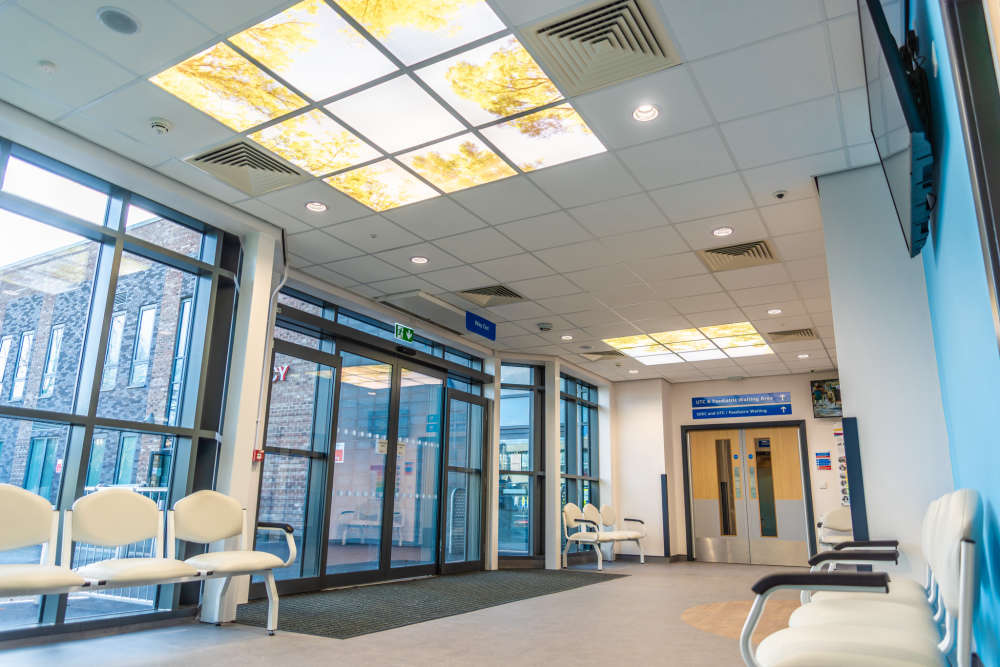
Images have been released showing the completed upgrade of A&E at the Countess of Chester Hospital, as early results show the changes are already improving how quickly patients are seen.
Around six months after the new approach was introduced, May was the hospital’s best month for emergency care performance in over four years, with 65.2% of patients seen, treated and either discharged or admitted within four hours – representing clear progress. Work to improve this further continues.
Demand for urgent care continues to rise, with attendances around 8% higher than this time last year and 19% higher than before the pandemic, meaning improvements like this are being made against a backdrop of increasing demand.
The improvements follow a major redesign of how patients are seen when they arrive. Instead of waiting in one long queue, patients are now assessed as soon as they enter the department and directed straight to the team best placed to treat them.
The final phase of the work has focused on children’s emergency care, with a newly refurbished paediatric A&E which is now open, including a redesigned waiting area, new family room and improved clinical areas, creating a calmer and more welcoming environment.
The investment focuses on what matters most to patients – how quickly they are seen and the environment they are cared in. Improvements include:
- A front-door triage system so patients are assessed as quickly as possible after arrival
- A refurbished A&E with improved spaces and facilities for people with different needs
- An expanded Discharge Lounge to help more patients go home sooner and to free up beds in the main hospital for other patients
- An expanded Urgent Treatment Centre so less urgent patients can be treated more quickly
Together, these changes are helping patients receive the care they need more quickly.
Around seven in ten patients are now assessed and directed to the right team within 45 minutes of arriving, meaning patients are seen much earlier in their visit.
The time it takes to make a decision about a patient’s care has also reduced by a third – from around three hours to two. This is how quickly clinicians decide what happens next. Faster decisions mean patients spend less time waiting for answers, helping to ease pressure in A&E, reduce overcrowding and make care safer.
Staff say the changes are already noticeable.
Dr Lottie Elliott, Lead Consultant within the Emergency Department, said:
“It feels like a different place when you walk in now. Patients are being seen much earlier and there is a calmer, more organised flow through the department. That’s better for patients and for staff.
“We’ve had really positive feedback from patients, from organisations like Healthwatch, and from colleagues visiting from NHS England and other hospitals. It’s not just a feeling – people can see that things are working differently.”
Hospital leaders recognise that many people still experience long waits when attending A&E, and that rebuilding confidence will take time.
Cathy Chadwick, Chief Operating Officer, said:
“We know people haven’t always had a good experience of A&E, and we understand why their confidence in us needs to be rebuilt.
“What these improvements show is that change is underway. We are clear though – this is early progress, not the end point. With demand continuing to rise, improving waiting times will become even more challenging, which is why progress like this matters. It will continue to come from small changes across every part of the service adding up to make a real difference to our patients – and we are committed to building on that.”
These changes are part of a wider shift in how urgent and emergency care is delivered across the hospital, with teams working more closely together across hospital and community services, rather than care being centred in A&E alone.
Further investment is planned as part of longer-term plans to continue improving urgent and emergency care at the hospital.
Pictured - ED Children’s resus bay/ Paediatric waiting room: The refurbished paediatric A&E includes a redesigned waiting area, new family room and upgraded clinical spaces, including a new children’s resus bay.
 Children and families in Cheshire to benefit from new Child Focused Courts approach
 Stoptober encourages residents to quit smoking as 100-day countdown to a smoke-free generation begins
 Residents invited to help shape the future of Whitby Park
 WREXHAM COMMUNITY THEATRE COMPANY RETURNS WITH BRAND NEW SHOW IN TIME FOR HALLOWEEN
 Blues Match Report: Lower Breck 1 - 2 Chester
 Appeal for information following serious collision in Chester
 Parents warn of “catastrophic tragedy” as school transport cuts leave 11-year-olds stranded on the A41
 Live Facial Recognition technology to be deployed in Chester this weekend
 Road to reopen as part of town centre
 £1 bus travel launched for young people across Cheshire West and Chester
 Peak Cluster carbon capture and pipeline project in Cheshire West and Chester
 Officers out in force in Blacon for Operation Decisive
 Neighbourhood Plan and Neighbourhood Development Order finalised for Blacon
 Free Park and Ride service available for Mold Food and Drink Festival visitors
 Countess of Chester Hospital NHS Foundation Trust’s response to the Thirlwall Inquiry
 Cheshire Police statement following the publication of the Thirlwall Inquiry report
Comments
Add a comment