

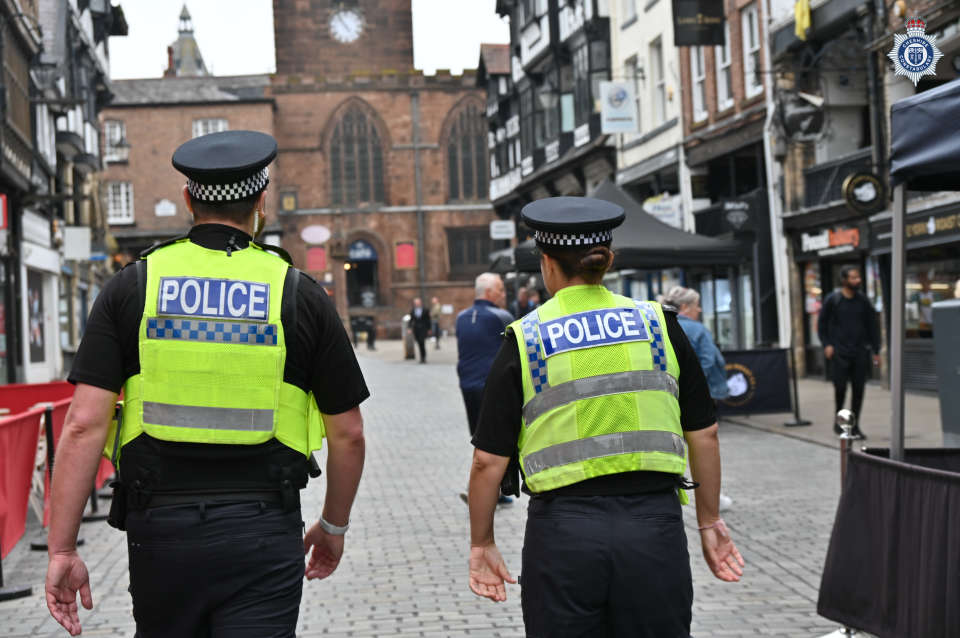
Cheshire Constabulary’s usage of Retrospective Facial Recognition has been highlighted as best practice following the publication of a national report urging police forces to improve their use of the technology.
Retrospective facial recognition (RFR) is a tool used to analyse images captured from CCTV, dashcams and social media. Any outstanding suspects who are matched with national police databases are passed on to an investigating officer and, once the images have been analysed, they are promptly removed from police systems.
A report from His Majesty’s Inspectorate of Constabulary and Fire & Rescue Services (HMICFRS) released on Thursday 12 November has urged forces in England and Wales and the National Crime Agency to improve their usage of RFR in to maintain public confidence in the technology.
However, Cheshire Constabulary’s own usage of RFR was praised several times within the report.
In response to the growing usage of facial recognition deployments, the Constabulary set up Operation Identifying, to analyse deployment outcomes. It found that cases involving at least one positive RFR match were more likely to result in a positive outcome, such as arrests and charge.
HMICFRS also highlighted how all Cheshire outcomes of RFR deployments were reported to a weekly crime accountability meeting. Whereas in some other forces, no clear structures were in place to oversee and manage the use of RFR.
Cheshire Constabulary uses its own in-house team to carry out its RFR searches, with personnel in this department completing a five-day facial recognition training course provided by the United States Federal Bureau of Investigation (FBI) to ensure that the technology is used effectively, as well as regular proficiency testing to assess their competence in RFR searches.
Between April 2025 and March 2026, Cheshire Police carried out 24,018 retrospective facial recognition searches. Relative to the total number of crimes recorded, this was the highest level of use of any police force in England and Wales.
An example of Cheshire's best practice usage of the technology was highlighted in the report, referencing a case in which officers attended a knife-point robbery in Crewe. They carried out an urgent RFR search within 10 minutes and identified a suspect seen catching a train to London.
British Transport Police officers were then contacted and stopped the train, arresting the suspect and recovering the stolen property. He subsequently received an eight and half year prison sentence.
Our own Facial Recognition Team also recently won the Staff Team of the Year award at our internal Achieving Cheshire Excellence (ACE) Awards in October. The team's efforts in increasing submissions by 46% and achieving a record 142 positive identifications in a single month were amongst the reasons behind their nomination and subsequent win.
Head of Forensics Chief Inspector Darren Griffiths said:
"The use of facial recognition technology has allowed enquiries into crimes to be progressed at a greater pace as opposed to traditional means of manual image comparison done by hand.
"Retroactive Facial Recognition can positively identify suspects within seconds and with minimal room for error. However, as the report from HMICFRS suggests, there are a number of safeguards that need to be implemented to ensure that this continually evolving technology is governed correctly and ensure public confidence in it.
"With that said, I am incredibly proud to see the work of our in-house facial recognition specialists has been recognised on several occasions as exhibiting best practice in terms of usage accountability, training and the wider deployment of the technology itself.
“We know that people understandably have questions about how the technology works and what it does and doesn’t do. It does not store images of the general public, it does not track people, and it is not used for mass surveillance. Keeping residents safe is at the heart of everything we do, and RFR just one of the many tools are our disposal to help us locate people who may pose a risk to the public and achieve justice for victims of crime."
Members of the public can find more information about Facial Recognition on the Constabulary’s website, including details on how the technology works and the safeguards that govern its use.
 Flintshire in line for a share of £20m bus transformation funding
 Blues Match Report: Spennymoor Town 0 - 5 Chester FC
 Chester & Wirral Football League - Latest Results
 PCC funding helps Street Angels keep Chester safe after dark
 Local Transport Implementation Plan Consultation Launched
 Blues Match Preview: Spennymoor Town v Chester FC
 Civic leaders tour Countess of Chester Hospital's Women and Children's Building
 Place Making Plans adopted for Flint and Mold
 HERITAGE BUSES AND STEAM TRAINS JOIN FORCES FOR NEW YEAR'S DAY
 Ellesmere Port Christmas Lights Switch
 Two charged following firearms deployment in Blacon
 National week of action tackling knife harm in Cheshire launches today
 MUSIC FROM SHAKESPEAREAN FILM TO BE PERFORMED AT CATHEDRAL CONCERT
 Blues Match Report: Avro 4 - 1 Chester
 Cheshire’s Special Constabulary receives King's Award for Voluntary Service
 Indian man jailed following Cheshire’s largest online child abuse investigation
 Blues Match Preview: Avro v Chester FC
 Chester Instagram drug dealer jailed
 Constabulary intensifies action on the sale of illegal tobacco products
 Experience Chester at Christmas with late night shopping and extended Park & Ride