

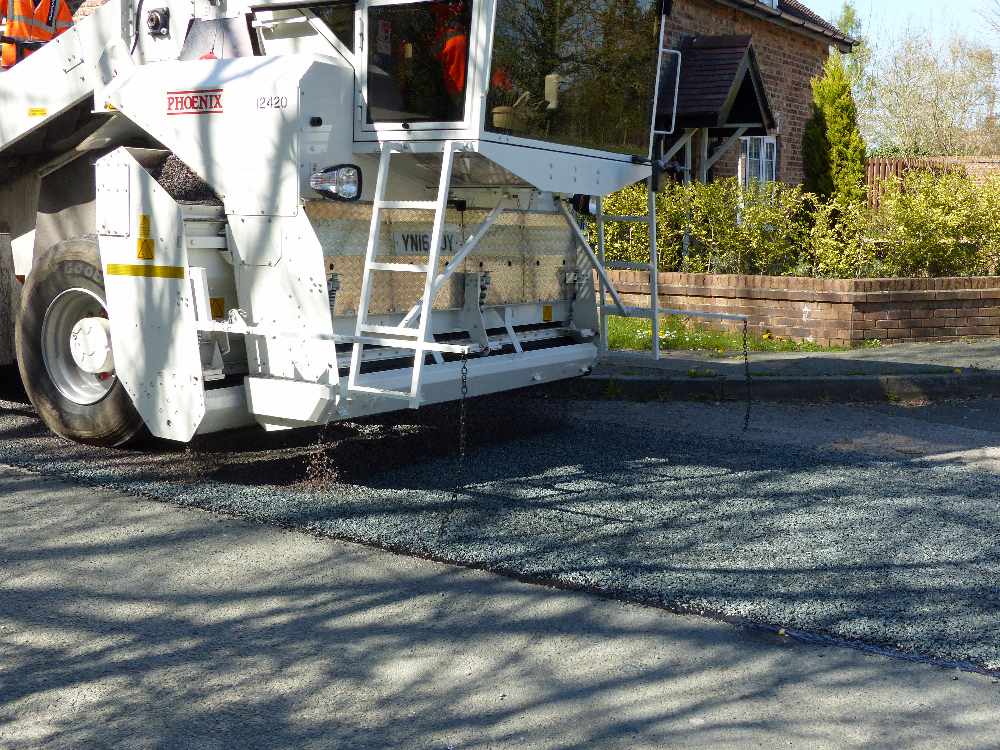
Cheshire West and Chester Council has started this year’s surface dressing programme which will help to prolong the operational life of roads and avoid the need for expensive future repairs and roadworks.
The process involves spraying the road with a layer of hot liquid bitumen (known as a binder) and then covering it with loose stone chippings. The dressing is then rolled, which together with the actions of slow-moving traffic, embeds the stone chips into the road surface.
Traffic can be allowed to run on the new surface almost immediately, avoiding lengthy closures and disruption. Also, the speed with which it can be laid reduces delays to traffic.
The Council’s Deputy Leader and Cabinet Member for Environment, Highways and Strategic Transport, Councillor Shore said: “Surface dressing is a simple and highly cost-effective method of repairing the road surface. It seals the road surface to prevent water getting in and causing damage; and, because it provides a hard-wearing surface with good texture, it also has anti skidding properties. This added protection can extend the life of the road surface by up to 10 years.
“It is also one of the most environmentally friendly ways to repair a road because the existing road surface is left in-situ and only a thin layer is added on top.
“Our Highways team is also trialling a number of other methods of treating and refreshing our roads, including Rhinophalt – this method uses a cold spray to seal the surface of the road and can be applied at night, minimising disruptive for motorists.”
Surface dressing is a weather sensitive process and works can be delayed by both wet, cold and very hot weather. The current programme is on the Council’s website.
Thing to be aware of if surface dressing is happening near you - during the early life of the surface dressing:
- The bitumen used can become soft again during very warm weather.
- Bitumen and chippings could be picked up on footwear, wheelchairs, pushchairs, pets’ paws and carried into houses.
- The carriageway is safe to drive on following application of the stone chippings, provided speeds remain below 20mph. For your safety and the safety of others, please drive slowly, keep your distance, avoid turning or braking sharply and do not overtake.
- Contractors will sweep the road and footpaths to remove loose chippings before the road is opened to traffic again.
- Contractors then return to remove loose chipping again as follows:
-
-
- 24 hours after the road opens,
- Then three to four days after,
- Then again seven days after.
-
 Continued parking chaos at Wrexham Maelor Hospital
 Residents invited to have their say on draft Transformation Strategy
 Family of "beautiful" son who died following Chester collision pay tribute
 Chester and Wirral Football League - Weekend Round Up
 Back to the Future event to be held at Picturehouse Cinema
 Children and families in Cheshire to benefit from new Child Focused Courts approach
 Residents invited to help shape the future of Whitby Park
 WREXHAM COMMUNITY THEATRE COMPANY RETURNS WITH BRAND NEW SHOW IN TIME FOR HALLOWEEN
 Blues Match Report: Lower Breck 1 - 2 Chester
 Appeal for information following serious collision in Chester
 Parents warn of “catastrophic tragedy” as school transport cuts leave 11-year-olds stranded on the A41
 Live Facial Recognition technology to be deployed in Chester this weekend
 Road to reopen as part of town centre
 £1 bus travel launched for young people across Cheshire West and Chester
 Peak Cluster carbon capture and pipeline project in Cheshire West and Chester
 Officers out in force in Blacon for Operation Decisive
 Neighbourhood Plan and Neighbourhood Development Order finalised for Blacon
Comments
Add a comment