

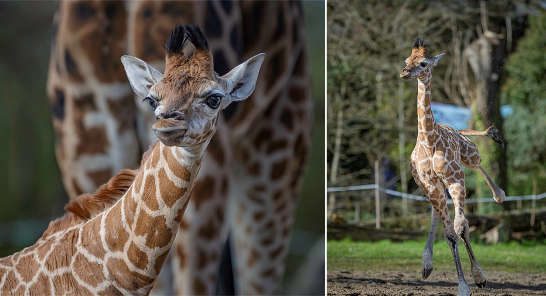
A rare two-week-old giraffe calf has kicked up her heels on her first outdoor adventure at Chester Zoo.
The leggy newcomer has stepped out for the first time alongside new mum Orla, dad Meru and the other eight Rothschild’s giraffes in the herd.
Zookeepers have revealed the not-so-little-youngster, who already stands at more than 6ft tall and weighs 100kg, to be female and have named her ‘Edie’ (pronounced e-dee).
Named after Lake Edward in Uganda, one of the African Great Lakes, her moniker is inspired by the zoo’s conservation efforts in the country.
Rothschild’s giraffes are one of the world’s most at-risk mammals, with just 2,500 remaining on the planet.
Conservationists at the zoo say Edie is a ‘important addition’ to the international conservation breeding programme, which is working to secure the future of the species.
Sarah Roffe, Team Manager of giraffes at the zoo, said:
“Giraffe calf Edie has spent the last couple of weeks bonding with mum Orla and the rest of the herd in a cosy nest area and, despite getting to her feet within minutes after the birth, her long legs have taken a little time to get used to. But now she’s looking really strong, having already gained 30kg since being born, and so it’s time to head out with the herd.
“It took no time at all before she kicked up her heels and raced outside into the sunshine on her very first outdoor adventure, where she was running in between the legs of the adult giraffes. Having a new youngster in the group always creates a bit of excitement and playful chasing – it is a real joy to watch!
“Edie is an important addition to the international conservation breeding programme in zoos across Europe and will go on to play a role in preventing the extinction of Rothschild’s giraffes, especially as so few remain in the wild.”
The Rothschild’s giraffe has been almost totally eradicated from Kenya, Uganda and Sudan as a result of habitat loss and hunting for their meat. The species now only survives in small, isolated populations – making them one of the most endangered subspecies of giraffe on Earth.
However, a new census carried out in Uganda in 2023 is giving conservationists reason to be optimistic. The new data has revealed that Rothschild’s giraffe numbers in two national parks, where the zoo and its partners are working to safeguard the species, has risen for the fourth consecutive year.
Mike Jordan, Director of Animals and Plants at the zoo, added:
“For nearly a decade we’ve supported our in-country partners, the Giraffe Conservation Foundation (GCF) and the Uganda Wildlife Authority (UWA), with their protection efforts across four national parks in Uganda, Africa, to help safeguard this incredible species.
“This has included the safe translocation of a number of giraffes from one area to another to help boost the genetic diversity of smaller, more isolated populations. Our teams also help on the ground in carrying out an annual census to monitor herds, while our partners provide around the clock veterinary care and remove snares from giraffes that have been targeted by poachers. In the last few years alone, they’ve successfully removed snares from nearly 400 giraffes – that’s more than 15% of the world’s remaining population.
“It’s a huge win for conservation that numbers are now beginning to slowly bounce back, something that is sadly incredibly rare in most species. While we remain optimistic and proud to have helped reversed the decline of these gentle giants, we know that we must continue in our efforts to secure a future where they go on to thrive.”
Rothschild’s Giraffe Fact File:
- Rothschild’s giraffes are one of the most endangered of the nine sub-species of giraffe
- They are named after zoologist Lord Walter Rothschild, founder of the National History Museum in Tring, Hertfordshire
- The species is identified by its broader dividing white lines and has no spots beneath the knees
- Once wide-ranging across Kenya, Uganda and Sudan, the Rothschild’s giraffe has been almost totally eliminated from much of its former range and now only survives in a few small, isolated populations Uganda and Kenya
- Research suggests that 2,500 Rothschild’s giraffes now remain in the wild
- Roughly one-third of the surviving population of Rothschild’s giraffes live in zoos where carefully co-ordinated breeding programmes are creating a safety-net population for the species
- The main threat to the species now is loss of habitat and poaching for meat and hides
- In the past, giraffes were hunted for their tails, which were used as good-luck charms, sewing thread and even fly swats
- Predators to the Rothschild’s giraffe include hyenas, lions, crocodiles and leopards
 Ellesmere Port and Bromborough MP urges rethink over BT jobs threat
 POPULAR CHESTER VIOLINIST ANNOUNCES SPECIAL GUESTS FOR CHESTER TOWN HALL CONCERTS
 Blues Match Report: Buxton 3 - 1 Chester
 Blues Match Preview: Buxton v Chester
 Third deployment of Live Facial Recognition technology to take place in Chester city centre
 Kings Moat Community Primary School has welcomed its first pupils
 Police appeal following ATM attack in Chester
 Major investment brings new generation dialysis technology to Countess of Chester Hospital patients
 Cheshire West and Chester Council launches final consultation on Frodsham Town Council review
 CHESTER THEATRE SAYS 'ALLO 'ALLO TO NEW SEASON OF PLAYS WITH CLASSIC COMEDY
 Blues Match Report: Chester 0 - 1 Merthyr Town
 Chester & Wirral Football League - Weekend Round Up
 POPULAR ACOUSTIC MUSIC NIGHT SET TO CELEBRATE 2ND BIRTHDAY WITH SPECIAL STORYHOUSE EVENT
 University of Chester ensures Dee Radio can broadcast from Chester, for Chester
Comments
Add a comment