

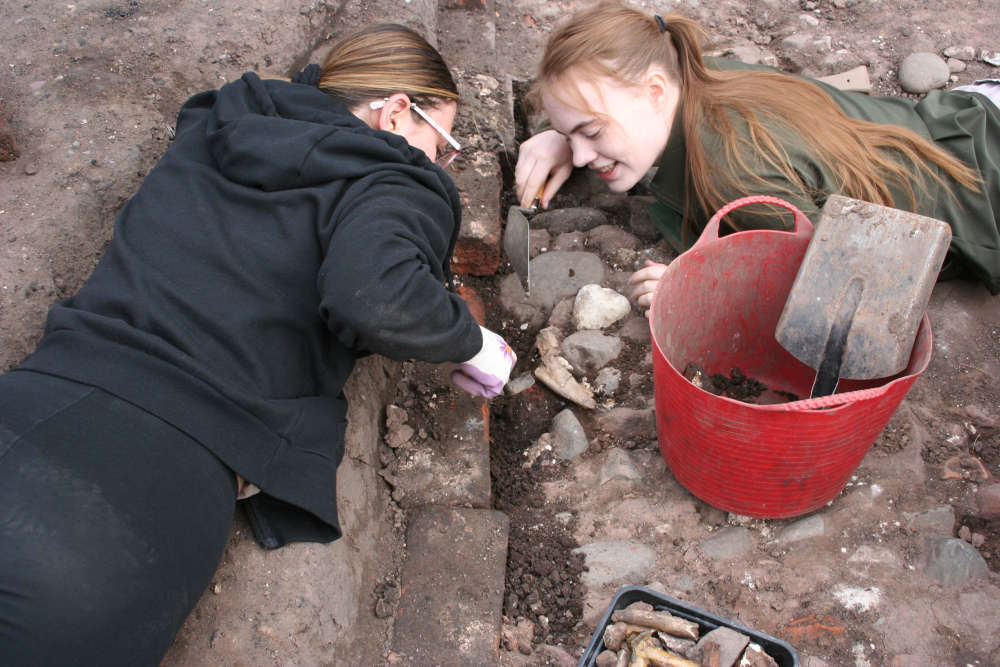
Grosvenor Park’s popular archaeological training excavation is returning to discover more about the past of Chester’s historic Grade II registered park.
From Monday 24 April until Friday 19 May University of Chester archaeology students will be learning practical fieldwork skills from local professional archaeologists. The excavation is run by West Cheshire Museums and is a partnership project between Cheshire West and Chester Council and the University of Chester’s Department of History and Archaeology.
The training excavations have been running since 2007 with over 330 students taking part, learning how to excavate and record the remains of nearly 2,000 years of activity within the area of the modern park. Their enthusiasm and willingness to engage with visitors has earned them much praise. As well as passing on skills to the archaeologists of the future, the project aims to find out more about the historic landscape surrounding Chester’s Roman amphitheatre and how the abandoned amphitheatre influenced the development of the area where the Church of St John the Baptist and Grosvenor Park now stand.
The remarkable discoveries made since 2007 include a Roman road leading towards the amphitheatre, a very large Saxon ditch, and a substantial medieval stone wall and ditch running north-south across the park, which probably enclosed the precinct surrounding St John’s church. In the late 16th century Sir Hugh Cholmondeley converted buildings at the eastern end of the precinct into a grand house that was later destroyed in the English Civil War, evidence of this destruction has also been found along with military equipment.
This year the excavation hopes to find answers to some of these questions:
- Is there any evidence for prehistoric buildings or farming similar to that found at the amphitheatre?
- Were there any buildings by the side of the Roman road?
- Was the Saxon ditch part of a fortification?
- What was happening in this corner of St John’s precinct in the later medieval period?
- What changes did Sir Hugh Cholmondeley make when he first bought the land?
If you would like to have a closer look at the excavations and the objects that have been discovered, there will be an open afternoon on Tuesday 16 May 1.30 pm to 4.30 pm, the event is free, and no booking is necessary. Visitors are also welcome to view the excavation Monday to Friday 9.30 am to 12.30 pm and 1.30 pm to 4.30 pm when students will be pleased to answer questions about their work and discoveries.
Students and staff will also be posting regular updates on their social media channels, follow this year’s discoveries #DigChester on:
Twitter @cwacmuseums and @HistArchChester
Facebook @GrosvenorMuseumAndStrettonWaterMill and @ArchaeologyChester
or Instagram @HistArchChester
You can find out more about the University of Chester’s degrees in Archaeology:
https://www1.chester.ac.uk/departments/history-and-archaeology
Pictured - Uncovering a mediaeval cobbled surface.
 Appeal for witnesses following graffiti on Chester walls
 Blues Match Report: Merthyr Town 1 - 2 Chester FC
 Blues Match Preview: Merthyr Town v Chester FC
 Chester and Wirral Football League - Weekend Round Up
 AWARD-WINNING COMEDY TO BE STAGED AT CHESTER LITTLE THEATRE
 Cabinet to defer decision on schools’ reorganisation proposal
 Local MP Justin Madders joins Gavin & Stacey star Alison Steadman to back Marie Curie appeal
 Make Your Food Go Further this Food Waste Action Week
 Council launches campaign to recruit more Shared Lives carers
 Men sentenced in connection with Cheshire West drug supply
 19TH CENTURY "GIRL POWER" SET TO BE CELEBRATED AT CHESTER CONCERT
 Blues Match Report: Chester 2 - 1 Darlington
 Blues Match Preview: Chester FC v Darlington
 Councillors urged to throw out proposals to merge four catholic schools
 Man jailed following Ellesmere Port phone robbery
 Charlie’s 20‑mile challenge brings joy to young patients at the Countess of Chester Hospital
 Local MP Marks World Book Day and Champions National Year of Reading Across Chester North & Neston
Comments
Add a comment